
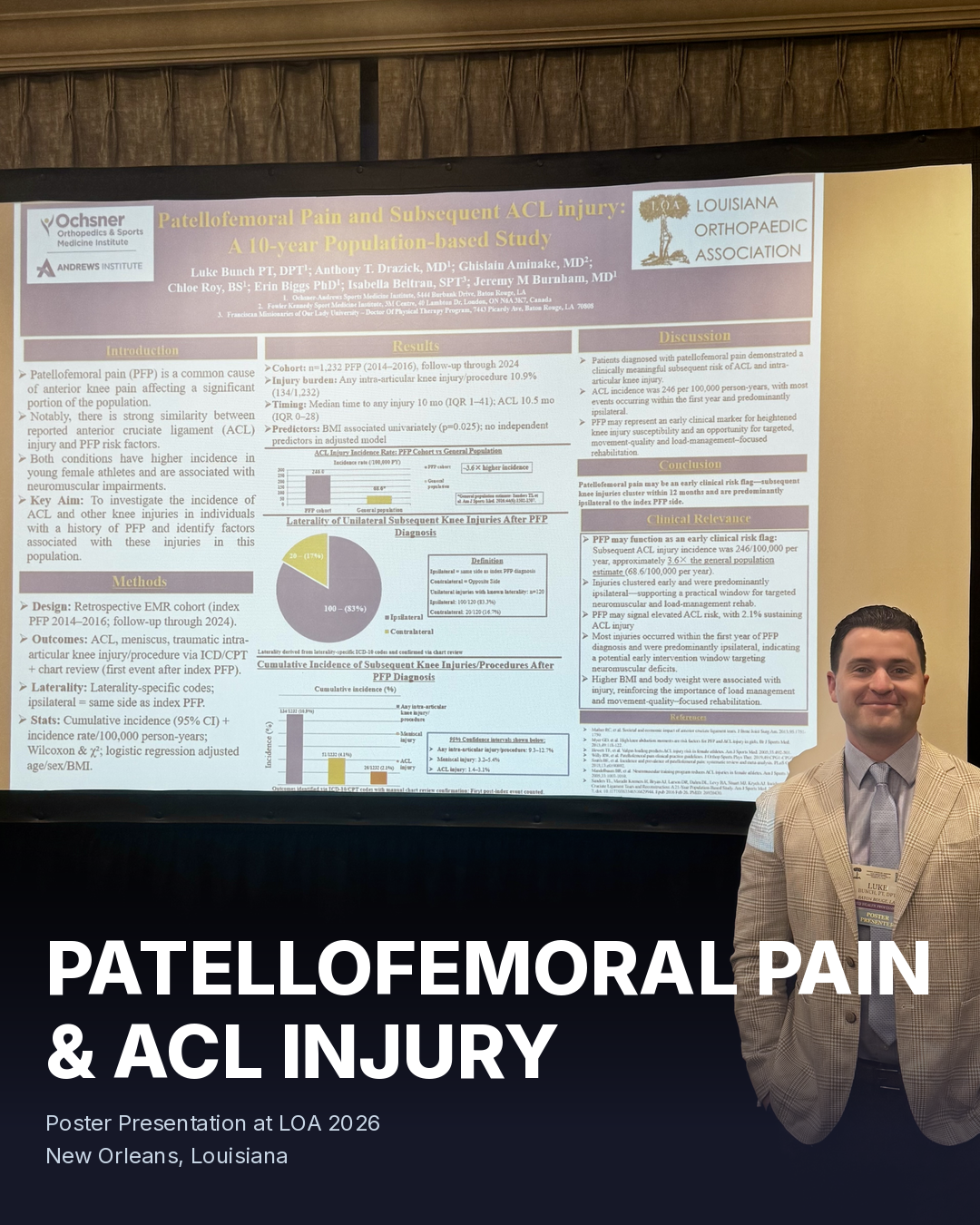
Luke Bunch, PT, DPT, OCS, SCS, physical therapist and coordinator of the ACL Center of Excellence at Ochsner-Andrews Sports Medicine Institute, presented a research poster at the Louisiana Orthopaedic Association 2026 Annual Meeting in New Orleans, Louisiana. The research examined whether patellofemoral pain (PFP) — commonly known as runner’s knee or anterior knee pain — predicts an elevated risk of subsequent ACL injury, using a 10-year retrospective population-based cohort design.
The findings offer a meaningful reframe for how clinicians approach PFP in young athletes: not just as a painful nuisance, but as a potential early warning signal for future ACL susceptibility.
Study Design: 1,232 Patients Over 10 Years
The study identified 1,232 patients diagnosed with patellofemoral pain between 2014 and 2018, then tracked subsequent knee injury outcomes through 2024 using electronic medical records. Outcomes included ACL injuries, meniscus injuries, and other intra-articular events, confirmed through ICD and CPT coding with chart review. A laterality-specific analysis compared ipsilateral versus contralateral injury rates, and logistic regression was adjusted for age and BMI.
Key Findings: 3.6x ACL Incidence
PFP patients demonstrated an ACL incidence of 246 per 100,000 person-years — 3.6 times the rate observed in the general population (68.6 per 100,000). Critically, 83% of subsequent knee injuries occurred on the same side as the original patellofemoral pain diagnosis. The median time to first subsequent injury was 10 months, with most events clustered within the first year after PFP diagnosis. This ipsilateral predominance points toward a biomechanical relationship between PFP and ACL injury rather than a systemic predisposition.

Clinical Implications
These findings support treating the first year after a PFP diagnosis as a critical intervention window. Rather than managing PFP in isolation with ice and rest, the data argues for laterality-specific neuromuscular screening and targeted rehabilitation — particularly for young athletes who may be at elevated ACL risk. Early recognition and proactive treatment during this window could meaningfully change the downstream injury trajectory.
The poster was presented at the LOA 2026 Annual Meeting, March 20-21, 2026, at the InterContinental Hotel in New Orleans, Louisiana. Study authors include Luke Bunch, PT, DPT, Anthony T. Drazick, MD, Ghislain Aminake, MD, Chloe Roy, BS, Erin Biggs, PhD, Isabella Beltran, and Jeremy M. Burnham, MD, from Ochsner-Andrews Sports Medicine Institute in Baton Rouge, Louisiana.
The Bottom Line
Patellofemoral pain may be more than an isolated nuisance diagnosis. In a 10-year population-based cohort, patients with PFP faced a 3.6-fold higher ACL injury rate than the general population, with 83% of injuries on the ipsilateral side. The data supports a shift in how clinicians view and manage PFP in young athletes — as an early ACL risk signal that deserves proactive, laterality-focused intervention starting in year one.
About the Author
Jeremy M. Burnham, MD is a board-certified orthopedic surgeon and Director of Sports Medicine at Ochsner-Andrews Sports Medicine Institute in Baton Rouge, Louisiana. Following his orthopedic surgery residency at the University of Kentucky, he completed his sports medicine fellowship at the University of Pittsburgh Medical Center (UPMC), where he trained under the late Dr. Freddie Fu, a pioneer of anatomic ACL reconstruction, Dr. James Bradley, a renowned sports medicine surgeon and longtime professional team orthopedist, and Dr. Volker Musahl, an internationally recognized ACL surgeon and researcher. His team physician experience spans professional sports teams, the University of Pittsburgh, and Southern University. With 127 peer-reviewed publications, book chapters, and scientific presentations, Dr. Burnham is the most published ACL surgeon in Louisiana. His research focuses on advancing ACL reconstruction, optimizing return-to-sport outcomes, and pioneering injury prevention, and has been recognized with the Game Changer Award from the Arthritis Foundation and the Playmaker Award from AOSSM. He serves as a site principal investigator for two federally funded clinical trials (NIH STABILITY 2 and Department of Defense STaR Trial). View full credentials and publications.